Pain is often felt in the groin, but it may also radiate to the thigh, buttock or knee.
Orthopaedics · Hip osteoarthritis
Hip replacement
If you have hip pain, limping, difficulty walking or increasing difficulty putting on socks, shoes or climbing stairs, hip osteoarthritis may be limiting your daily life.
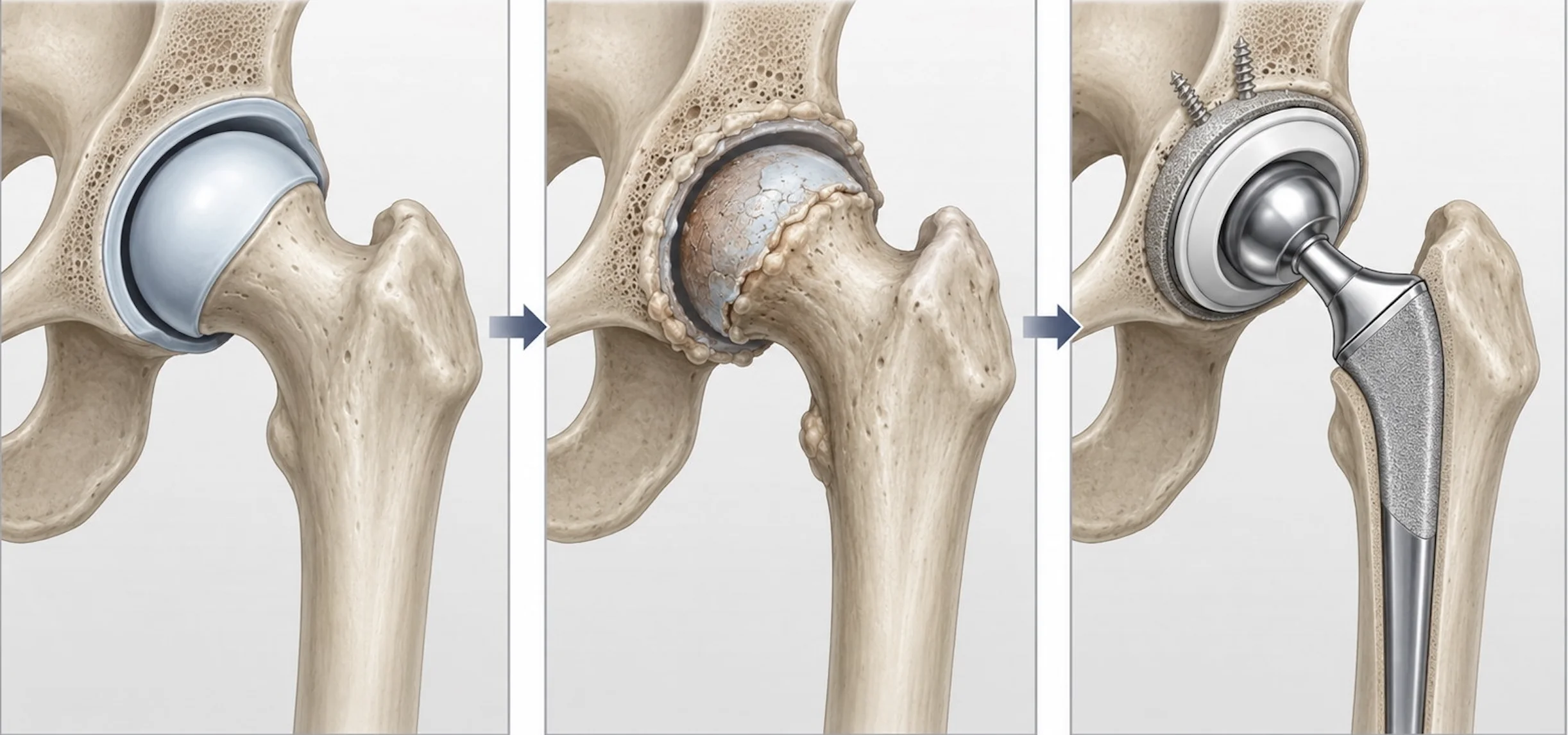
Do you recognise any of these symptoms?
Hip osteoarthritis usually progresses slowly. Patients often adapt their lives to the pain until walking, resting or doing everyday activities becomes difficult.
You may notice limping, the need to stop, or difficulty walking distances that were previously easy.
Putting on socks, tying shoes, getting into a car or standing up from a low chair may become difficult.
When pain also appears at night or at rest, it may indicate more advanced osteoarthritis.
What it is
A hip replacement substitutes the worn hip joint.
The hip works as a ball-and-socket joint: the femoral head fits inside the acetabulum of the pelvis. When cartilage wears down due to osteoarthritis, the joint surfaces rub against each other and pain, stiffness and loss of mobility may appear.
Hip replacement substitutes the damaged parts with artificial components designed to reduce pain, improve mobility and restore independence in daily activities.
When to consult
You do not need to wait until the pain becomes disabling.
Consult a specialist if:
- Hip pain limits your daily life.
- You are walking less or limping more.
- You struggle to put on shoes, socks or climb stairs.
- Pain also appears at night or at rest.
- Medication, physiotherapy or injections no longer help.
Surgery
The aim is to walk again with less pain.
In hip replacement surgery, the worn joint surfaces are removed and components are placed to replace the femoral head and acetabulum. Surgery is planned according to anatomy, bone quality and the patient’s functional needs.
The indication is made individually. We assess pain, imaging tests, mobility, age, activity level and realistic recovery goals.
Recovery
Early mobilisation is a key part of the process.
In many cases, patients begin to stand and walk with assistance within the first 24 hours. Recovery depends on previous condition, age, muscle strength and adherence to rehabilitation guidance.
The aim is to progressively regain walking ability, confidence, mobility and everyday activities. Recommendations are also provided on safe movements, walking aids and postoperative follow-up.
Common questions about hip replacement
When pain and functional limitation are significant and conservative treatments are no longer sufficient.
Modern implants are highly durable, but this depends on factors such as age, activity, weight and implant type.
Walking with assistance usually starts early, depending on progress and medical instructions.
Many patients can return to low-impact activities progressively and following recommendations.
You may also be interested in
Related information to better understand osteoarthritis, joint replacement surgery and functional recovery.

Orthopaedics
Knee replacement
Treatment for advanced knee osteoarthritis when pain limits daily life.
Read more
Technology
Surgical planning
Technology applied to precision, safety and personalisation of surgery.
Read more
Medical team
Orthopaedics and spine
A coordinated team to assess joint disease, spine conditions and functional recovery.
Read more
Medical assessment
Would you like to know whether you need a hip replacement?
We review your symptoms, mobility and imaging tests to clearly explain whether conservative treatment is still an option or whether hip replacement may help you.